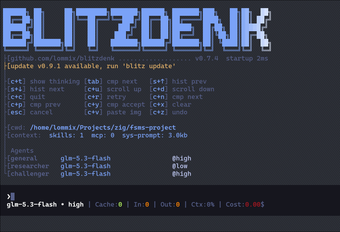
Terminal-first AI assistant for local code context and localization tasks
blitzdenk, created by Lommix, is a Rust-based terminal AI assistant aimed at developers and localization engineers. It supplies language models with automated project context so they can perform code analysis, localization, and refactoring from the command line. The app pairs a concise terminal user interface with local memory, project file reading, and web crawling capabilities to give context-aware responses. It's designed for Neovim, Tmux, and other terminal-first workflows that need in-place AI assistance.
What tasks you can actually use it for
The app targets practical developer tasks: code analysis, project refactoring, and text localization directly inside a project folder. It supports web crawling from the chat interface to fetch documentation, and it can run searches across a codebase so models can answer questions grounded in the current repository. For model selection, the tool supports multiple providers, enabling comparisons between different model outputs on the same local context.
How it builds reliable project context for prompts
The tool follows an auto-context approach, reading file contents and git history so prompts include concrete, local information. It uses command-line utilities for discovery and indexing, and it writes a local memo.md to persist project state between sessions. Because the model inputs reflect actual files and commit logs, generated responses avoid generic guesses when source material is available.
What inputs and platform requirements limit its use
The app runs on Linux and macOS and relies on standard CLI utilities and runtimes. Required components include:
- ripgrep and tree for project traversal
- Node.js version 18 or later for certain MCP components
- connectors for OpenAI, Anthropic, Gemini, and local Ollama models
Those dependencies mean setup favors environments already configured for development rather than fresh desktop installs.
How it fits into a terminal-centric developer workflow
The interface is a minimalist, no-border TUI tuned for embedding in terminal buffers such as Neovim, and the tool is implemented in Rust to keep resource use low compared with Electron-based alternatives. It also offers an autonomous execution state that can apply changes to the working tree, which accelerates iterative work but requires deliberate review practices in team settings.
Best suited as a context provider inside agent-driven development workflows
Because the tool exposes its project-reading and manipulation tools via the Model Context Protocol and is built on the blitzagent framework, it functions well as a context provider for other agents and automated pipelines. Teams that plan to integrate agent-to-agent automation should set governance and review rules first. The tool is most valuable when paired with established terminal toolchains and clear controls around automated file changes.